Two pointer
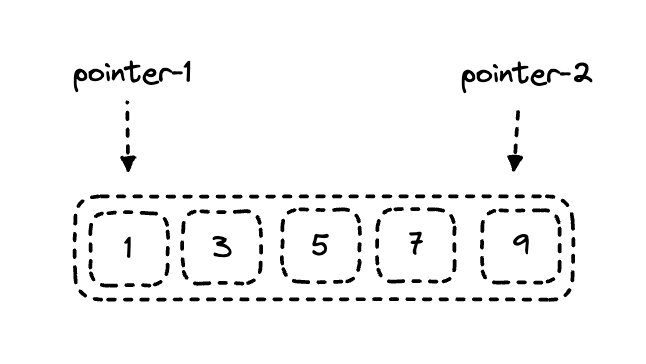
The Two-Pointers Technique is a simple strategy where you use two indices (pointers) that traverse a data structure—such as an array, list, or string—either toward each other or in the same direction to solve problems more efficiently
When to Use Two Pointers
Sorted Input: If the array or list is already sorted (or can be sorted), two pointers can efficiently find pairs or ranges. Example: Find two numbers in a sorted array that add up to a target.
Pairs or Subarrays: When the problem asks about two elements, subarrays, or ranges instead of working with single elements. Example: Longest substring without repeating characters, maximum consecutive ones, checking if a string is palindrome.
Sliding Window Problems: When you need to maintain a window of elements that grows/shrinks based on conditions. Example: Find smallest subarray with sum ≥ K, move all zeros to end while maintaining order.
Linked Lists (Slow–Fast pointers): Detecting cycles, finding the middle node, or checking palindrome property. Example: Floyd’s Cycle Detection Algorithm (Tortoise and Hare).
Optimization Over Brute Force: If brute force needs nested loops (O(n²)) but you suspect a more efficient way using two moving indices